
Captives Set to Increase Cyber Coverage in 2020

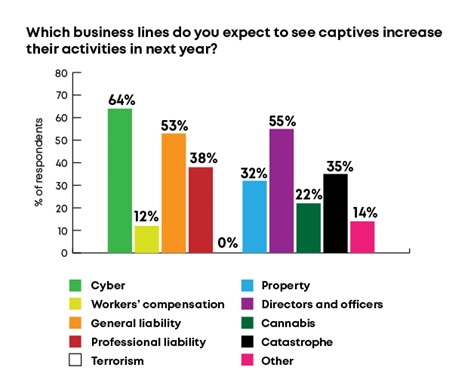
Captive International surveyed its readers about which business lines they expect to see captives increase their activities in for 2020 (respondents were permitted toselect multiple answers).

Cyber coverage came in first, with 64 percent of respondents predicting captives will increase their activities in that area.

Directors and officers (55 percent) and general liability (53%) were the next most popular choices, followed by professional liability (38%) and catastrophe (35%).

Notably, workers’ compensation, which is one of the lines most closely associated with captives, was only selected by 12 percent of respondents. It is likely that captives which need this coverage are likely already writing it.

There has been a lot of discussion about captive coverage for cannabis growers, only 22 percent saw this as a growth area for captives next year.

Many of the respondents to the survey said their focus will be on areas with the biggest rate rises in 2020 making the question, in effect, a prediction about where rates will rise.

Published in Captive International.

Partnering with SIIA to Shape Captive Insurance Policy in DC

By Sandra Fenters

Over the last 5 years, we have seen a whirl wind of activity around captive insurance in Washington. Some very positive; some less so.

Consider the following:

  • Farm mutuals received a boost with the 2015 PATH (Protecting Americans from Tax Hikes) Act.
  • In the initial versions, small business captives (taking the 831b election) were originally omitted, but with some lobbying, they were ultimately included in the final bill. Consequently, these captives enjoyed a healthy increase in tax deductibility limits of insurance premiums; this was a big boost for small business captives, and it looked like the captive market for small businesses would boom.
  • The Treasury and IRS had seen abuses over the years with select captive plans and began to cast a suspicious eye on many existing captive policies. The IRS issued a series of onerous Notices (for example: 2016-66), ramped up audits and filed a number of lawsuits to target broadly any possible abuses.
  • Part of the challenge was that Congress did not specify much of the detail of the new rules which led to industry and government confusion.
  • So despite the gains for small business captives (taking the 831b election) in 2015, an aggressive IRS has muted much of the gains.


Helping to Steer the Policies

With this uncertainty, SIIA (The Self-Insured Institute of America) and its Captive Advocacy Team have been active for the last few years to help shape the legislation and policies related to small business captives utilizing the small captive tax election.

I have been active on the Captive Advocacy Team since 2015 and have made over a dozen trips to DC to support these efforts. We focus on informing the legislators about the benefits of captives and are aware of the onerous reporting requirements.

My most recent trip was this Spring when colleagues and I met with the legislative teams of Richard Burr (NC), PatToomey (PA) and David Perdue (GA). During the blitz, 13 SIIA Advocacy Team members met with 38 legislative teams.


SIIA Advocacy Going Forward

Ryan Work, Vice President, Government Relations of SIIA, leads this governmental advocacy program and comments that after a few years of a more reactive mindset of ‘putting out fires,’ the Team plans to be more proactive in its lobbying efforts in Washington.

My next scheduled visit is November 20, 2019.

Please let me know if you have any questions or input on this program.

Gaining Momentum: Hybrid Captives

By Sandra Fenters

Clients have traditionally looked to captive programs as a business strategy to protect their businesses by insuring property and casualty coverage gaps and/or their enterprise risks not covered in the traditional market.

Importance of Human Capital

One trend we’ve seen gaining momentum for a number of years is business owners looking to better manage the risks and costs on what many view as their ‘most important’ asset: their human capital.

These owners are asking us how they can utilize their existing captive structures to:

  • insure their employee benefits,
  • improve safety programs,
  • enhance risk management techniques, and
  • encourage behaviors to avoid certain types of risk.

For those with existing captives, particularly with property and casualty licensed captives, we are able to formally request a business plan change to add coverages, such as medical reimbursement.

‘Blend’ Captives

This is a hybrid type of program which allows the captive to issue property casualty policies, enterprise risk policies and some health care-related policies.  It is a  true blend.

What Does This Mean for Existing Captives?

There are ‘moving parts’ with all captives, but there are additional things to think about when writing coverages that involve your Company’s Human Capital, including but not limited to educating yourself on requirements of The Department of Labor and ERISA.  If you add such coverages, you may notice changes within the captive, including the following:

  • It changes balance sheets.
  • There are different requirements around reporting to regulators.
  • It alters required loss reserves.

Therefore, some caution is warranted.

But there are certainly advantages for some Companies to add coverages, such as medical reimbursement to their underwriting program, and we expect to continue to see this trend.

Questions?

If you have questions about how such a plan could benefit you, please contact us.

Capterra Risk Solutions, LLC

842 5th Avenue

Coraopolis, PA 15108

412-802-2600

information@capterrarisk.com

IRS Announces Settlement Offers for Select Captives


Update from Sandra Fenters

The IRS issued a notice earlier this week which provides a settlement offer to certain taxpayers who are currently under audit and possess bad fact patterns within their captive program.

According to DugganBertsch, the IRS has touted several recent victories with respect to “micro-captive” transactions, but these cases have illustrated bad taxpayer fact patterns that were strongly in the IRS’s favor. By litigating these bad fact pattern cases first, the IRS hopes to discourage taxpayers with stronger fact patterns from continuing their defense of their positions. However, many of the several hundred pending cases in Tax Court have more taxpayer-favorable facts and circumstances; they are likely to create a more favorable precedent.

Capterra Risk is very active on Capitol Hill, and our staff regularly conducts Congressional meetings focused on key committees of jurisdiction, including Senate Finance and House Ways and Means, as well as leadership and Chairman offices. This ongoing engagement centers around educating Members of Congress and their staff about captive insurance in general, the importance of risk mitigation and the issues facing the captive owners and managers. As part of this effort, Capterra is working to establish a set of proactive principles to help further advance and benefit the industry, in partnership with state and federal regulators.

While the recently announced settlement only applies to a small percentage of captives under current IRS examination, we wanted to make you aware of the Notice.

If you would like to discuss this news further, please contact Capterra Risk at 412.802.2600.

Sandra Fenters Discusses Benefits and Trends of Captives

In this wide-ranging interview, Sandra and Mike discuss:

  • Trends in captive insurance including (1) expanding captives to cover a company’s most valuable asset, its employees and (2) growing market for Enterprise Risk Captives (ERCs) for the middle market
  • Challenges by the IRS about suspected captive abuse
  • SIIA’s work on Capitol Hill to positively impact legislation

Is Captive Insurance Right for Your Construction Business?

Every firm deals with risk. Yet risk is particularly significant for companies in the construction industry.

Consider some of the obvious risks and dangers at a construction site:

  • Active use of equipment and tools
  • Strenuous work by team members such as climbing and lifting
  • Moving large amounts of raw materials and heavy building supplies
  • Weather events or lack of supplies causing business interruption
  • Theft of supplies and equipment
  • Workmanship defects or design errors
  • Pollution and environmental liability

In addition, it is very common for construction firms to engage external teams such as suppliers, contractors or sub-contractors who bring with them their own set of processes and risks.

It is not hard to spot the many challenges in managing risk at a construction business.

Managing this risk

Savvy construction firms spot these risks and take steps to limit their exposure.

Yet, commercial insurance is often not the best fit for construction firms to manage these risks as the insurance can be expensive and still leave major gaps in coverage.  To fill the gaps, construction firms often need to pay significant premiums.

Construction companies increasingly look at captive insurance as a way to manage their unique risks and even reduce costs.

Case study: Captive Insurance as a Risk Management Tool

We share an example of a construction firm which finds significant risk in missing deadlines.

Click here to view the firm’s risks and how a captive would benefit the firm.


What is captive insurance?

A captive insurance company is a form of self-insurance organized for the primary purpose of providing insurance protection to its parent company (operating company), owners, and/or related entities.

For decades, large corporations have established captive insurance arrangements to create a tailored insurance portfolio to fit specific needs. Today, closely held businesses including construction firms are also taking advantage of the numerous benefits afforded by captive insurance arrangements.

What are the benefits for construction firms?

There are a number of benefits of creating a captive insurance company:

  • Stabilized insurance budgets – have consistent expenses around insurance
  • Improved claims handling– the firm controls the claims review process
  • Creation of profit center– firms keep underwriting profits, providing an incentive for loss control measures

Many construction firms have sought out more information on captives given these benefits.

What should we do to properly manage our firm’s risk?

Managing risk should be a full program utilizing traditional insurance, captive insurance, and means of risk mitigation such as safety procedures. Risk management should be reviewed at least annually as the Company grows.

The benefits of forming a captive company can be fully realized when owners partner with experts such as Capterra Risk Solutions. As your Captive Manager, Capterra Risk will help you look at the big picture of how you manage your risk so that you are aware of potential exposures and make educated decisions on your overall insurance program.

Contact Capterra Risk Solutions today to learn more.

Contact Information:

Capterra Risk Solutions, LLC

842 5th Avenue

Coraopolis, PA 15108

412-802-2600

information@capterrarisk.com

Captive Insurance as a Risk Management Tool

Captive Insurance in the Construction Industry

By Sandra Fenters. Originally published in Breaking Ground

Consider the following hypothetical situation: BJF Contracting was the low bid winner on a North Shore area project for the City of Pittsburgh. The project consisted of building a retaining wall to stop a steep hill from washing onto a local road. Closure of the road was necessary during construction. In order to ensure the road was reopened on schedule, the City had a $2,500 per day liquidated damage clause (LDC) in the contract.

The specifications for the concrete retaining wall called for a special type of cathodic protection to prevent rebar corrosion. There were only two suppliers of this protection system, one in Canada and one in Oregon. BJF subcontracted with the Canadian company, and included the LDC in the subcontract.


Failure of Subcontractor

Two months later the road was closed, the forms were ready, and the Canadian subcontractor arrived on site with the wrong type of material for the protection system. The inspector would not permit installation of anything but the specified product. Unfortunately, the Canadian subcontractor did not have the specified product in stock. To mitigate damages, BJF hired the Oregon subcontractor to complete the work. BJF had to pay an additional $4,800 to the Oregon subcontractor, 12 days of liquidated damages, as well as other jobsite costs incurred during the delay.

BJF is out $54,000 and files suit against the Canadian company for breach of contract. The court ruled that the LDC was in fact a penalty clause and unenforceable, since the subcontract value with the Canadian company was only worth $13,000. The only damage BJF could collect was the $4,800 for their reliance interest.

Unfortunately, this is not an uncommon occurrence in the day to day life of a contractor. Unforeseen exposures rear their ugly head on job sites every day which is why managing and mitigating risk factors, including safety issues, is so critical to the health of a contractor’s balance sheet.

What are your everyday risks?

Have you ever taken an inventory of the risks you inherently absorb in your business everyday as a contractor? Some of the risks you already mitigate by way of paying premiums to the traditional insurance marketplace include workers compensation, auto liability, and general liability.

But what about the risks you assume every day in contracting that are not insured by the traditional marketplace? Possibly risks such as job-site pollution, extensive punch lists, subcontractor disputes, engineering defects and unforeseen conditions the owner will not recognize, and liquidated damages as seen with BJF Contracting? These hazards are often the events directly affecting the profit margin on a project versus a well-thought out estimate. The estimators probably calculate some of the costs associated with these unforeseeable challenges, but if weighted too much in the estimate, you lose the bid.

What could they have done to help prevent or offset the liquidated damages with the City? Typically it is the operational managers of a construction company who try preventing the type of loss incurred by BJF Contracting. While the operational staff works to mitigate these risks, the CEO or CFO can also work to protect the company from these unexpected losses, beyond the utilization of the traditional insurance marketplace.

Challenges of Construction industry

The construction field is an industry class that has historically been rated by the traditional insurance market as “high risk.” The demand for the use of alternative risk finance mechanisms, known as captives*, by contractors began to increase with the advent of the hard insurance market cycle in the early 2000’s. As the soft market quickly dissipated during this time, traditional carriers were restricting coverage and increasing rates industry-wide. The result was the best-in-class companies began subsidizing the worst-in-class, forcing contractors to seek alternative forms of procuring insurance. Today a majority of mid-to-large size contractors are participating as members of a group captive arrangement, either homogeneous (i.e. National Roofers Association) or heterogeneous (multiple trades) in nature.

Joining a group insurance arrangement with like-minded companies is not uncommon in the construction industry. If structured properly, these group captives can provide protection for traditional statutory coverage such as workers compensation and auto liability, and at the same time return investment income and an underwriting profit as a result of good loss experience to the members of the group. While group captives harness these important aforementioned benefits for its members, they are an extension of the traditional market place, not a replacement thereof. In other words, in a group captive environment, coverage may not have been afforded for the loss experienced by BJF Contracting.

In addition to group captives, there are many types of captive arrangements available to assist contractors with strategic planning and if your trusted advisors are not talking to you about these, they should be. Specifically, have you ever entertained the idea of owning your very own insurance company?

Are captives available for smaller companies?

It is often a misconception that owning your own insurance company, referred to as a pure single parent captive, is an option not afforded the closely held businesses and their respective owners. While it was once believed that only the publicly traded companies and large well-capitalized private companies could take advantage of the numerous benefits afforded by owning your own insurance company, it is no longer the case.

Actively participating in a group captive arrangement does not preclude a business and its owner from creating its own separate profit center by way of a single parent captive that would underwrite the risks endemic to the construction industry that are inherently and historically self-insured by the owner. By converting the characteristics of a self-insured arrangement (i.e. liquidated damages) to a captive insurance company arrangement, the business may be able to accelerate the deductions of the premiums as an insurance expense to the operating company and the captive may be able to build up reserves and policy holder surplus in a tax advantageous manner.

Harnessing all of the benefits of owning your own captive insurance company, including the tax benefits, is simply prudent strategic planning. As long as the proverbial tail (tax) is not wagging the dog (insurance and business purpose), you should have a solid foundation for your captive to build upon. “Tax litigation has taught that a captive, in order to justify its tax benefits, must demonstrate economic substance and business purpose independent of such tax benefits. This does not mean that a captive cannot openly pursue the tax advantages that ensue from qualifying as an insurance company. Instead it means that the simple pursuit of federal tax advantages is not enough to sustain the decision to create a captive.” [1]

What if BJF Contracting had implemented its own single parent captive? First, the contractor would have paid premiums over the course of the year, creating a deductible expense for the contractor in year one and all subsequent annual renewals. Those premiums would have then accrued within the captive, earning investing income, free from third party creditors and liability. At the time of a claim, BJF Contracting would seek reimbursement from its captive for the total loss amount of $54,000 plus legal fees.

In the absence of the captive, BJF incurs those expenses within the contracting business however, the deduction is not allowable until the amount is actually paid, referred to as an “economic performance,” which might not occur until future accounting and/or tax periods. By implementing a captive the contractor smoothes out the affects of losses on cashflow, builds up reserves to be utilized for potential future claim activity that may be excluded by other sources of insurance, builds up surplus to be utilized to negotiate with bankers or sureties, and may also experience certain tax and asset protection advantages as well.

Closely held contractors, such as BJF Contracting, owning closely held captives, may be a perfect match for weathering through the soft and hard markets of both the construction and insurance industries.

* The term “captive” comes from Frederic M. Reiss, who coined the term while he was bringing his concept into practice for an industrial client in Ohio in the 1950’s, Youngstown Sheet & Tube Company. They had a series of mines where the ore was used solely for the company’s operation and its management referred to them as captive mines. When Reiss helped the company incorporate its own insurance subsidiaries, they were referred to as captive insurance companies because they wrote insurance exclusively for the captive mines. Reiss continued to use the term for his concept and both the captive and the term have adopted a far wider context.

[1] November 2008 Captive Review “When the tail wags the dog” Randy Beckie and Phil England of Anderson Kill & Olick.

Sandra Fenters is President of Capterra Risk Solutons, an insurance and risk management brokerage firm located in Pittsburgh.

Delaware Captive Insurance Association 2014 Spring Forum Highlights

We attended the Delaware Captive Insurance Association Forum on May 12th and 13th in Wilmington, DE.  The event was well attended with 79 participants from many disciplines all working in the captive space: attorneys, actuaries, CPA’s, captive managers, and Delaware regulators including the Insurance Commissioner, Karen Weldin.  The forum offered a great opportunity to meet with several key players working with captives domiciled in Delaware.

Sandra was asked to present Tuesday morning and conducted a lively session regarding policy construction with Andrew Rennick, Esquire of Gordon, Fournaris & Mammarella, P.A.  We had an interesting session with Steve Kinion, the Delaware Director, Bureau of Captive and Financial Insurance Products, where he shared his views on the National Association of Insurance Commissioners’ (NAIC) move to change the definition of multi-state insurers which may adversely affect captives.  Steve also went over his proposed changes to Delaware regulations primarily affecting series captives, as well as providing new loan guidelines for all captives.

One of the participants of note was Chaz Lavelle of Bingham Greenebaum Doll, LLP.  Chaz was the Tax Counsel for two key taxpayer victories in captive insurance cases including the Humana Inc. v. Commissioner which decided the “brother-sister” issue regarding risk sharing and risk distribution.

Great forum and time well spent!

Captive Benchmarking

Released last week at the 2014 RIMS Annual meeting, the Marsh report contains a lot of interesting information regarding captives.  Some of the benchmarks included were:

  • 66% of the total captive count are single parent captives
  • Of the captives treated as insurance companies for tax purposes, 47% use a “brother/sister” approach, 42% use third party risk, and 11% use a hybrid of the two approaches.
  • Of the non-traditional coverages written in captives, crime insurance tops the writings, with medical stop loss or another layer of a self insured health plan also growing in popularity.

See the press release and article here:

“Majority of US-Owned Captives Not Generating Tax Benefits: Marsh”- Article written by Marsh on Tuesday, April 29, 2014, Article posted by The Wall Street Journal on Tuesday, April 29, 2014

(http://online.wsj.com/article/PR-CO-20140429-915886.html)


And the full report:    “The Evolution of Captives: 50 Years Later” by Marsh USA published April 29, 2014:

http://usa.marsh.com/NewsInsights/MarshRiskManagementResearch/ID/37880/2014-Captive-Benchmarking-Report-The-Evolution-of-Captives-50-Years-Later.aspx

Vermont Signs New Captive Insurance Legislation into Law

“Vermont’s New Captive Insurance Legislation Signed into Law; Changes Strengthen Vermont’s “Gold Standard” Captive Insurance Legislation”

Article posted by PRWeb.com on Thursday, April 17, 2014

Press Release posted by Digital Journal.com on Friday, April 18, 2014

Vermont has just enacted new legislation which creates a “dormant” status for captives. The dormant status provides a way for a captive that has ceased insurance operations to cost-effectively retain its license should it elect to resume operations in the future.  (Bill H.563 amending Title 8) – Lynn H. Desmone, Account Executive, Capterra Risk Solutions (4/25/2014)


Read more here:

“New Legislation has passed in the Vermont State Legislature updating the state’s captive law. The new law, which takes effect immediately, amends the reciprocal insurer section and creates a new “dormant status for captives.” – Montpelier, VT (PRWEB) April 17, 2014 (http://www.prweb.com/releases/VermontCaptive/Legislation/prweb11771919.htm)


View the press release on DigitalJournal.com by clicking the link below:

http://www.digitaljournal.com/pr/1858264


To view “Bill H.563 amending Title 8” passed including amendments click on the following link:

http://www.leg.state.vt.us/docs/2014/bills/Passed/H-563C.pdf